Sunday, March 31, 2024

Crisis Protest - Essay #2

Crisis Protest

    Nobody expected to experience the worst economic challenges and political protests in Venezuela. Since 2002, protests in Venezuela have been very common, but the most significant protest began in 2013 when Venezuelans started to be more aggressive in the protest of the government. Everything began when Venezuelans selected Chavez to be president from 1999 to 2002, but people started to notice that Chavez was causing the country to deteriorate. In 2013 Chavez passed away, and Venezuelans started to celebrate his death. However, nobody imagined the nightmare Venezuelans were going to experience. Since Chavez’s death, Maduro has been the president of Venezuela, and things were deteriorating even worse. The previous protest was insignificant compared to the protest experienced in 2017. That one became a nightmare. Venezuelans, suddenly, started to mix the food, medicine, and gas crisis protest with the political protest, and nobody cared about the gravity of this situation. This protest had created a disaster, affecting each Venezuelan family physically and mentally.
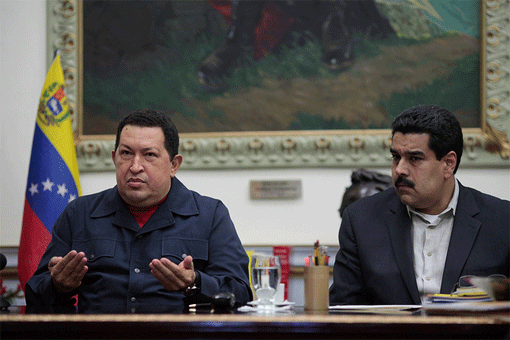
                    Hugo Chavez Successor Maduro - Who Will Replace Chavez

    During the protest, finding food was like discovering a treasure. Many Venezuelans killed each other just for a piece of bread. The desperation of some people unable to eat or feed their families guided them to death. In fact, this period was very traumatic in my upbringing because I saw my friends getting nothing for breakfast or lunch. Even though the situation was critical, I was thankful to my mom because of the three dishes she managed to provide for the day. Due to this crisis, my mom had to work hard to get food. She had to pay a little bit more and sometimes she contacted friends who could sell us food. That was the technique my mom used to feed us at that time. After days, the protest was getting worse, and my mom decided to create a storage at home. She transformed a walk-in closet into a big storage area, and my mom stocked minimum five packages of any item. For example, there was a rule that there shouldn’t be less than five packages of water, bread, or pasta. Anything but no less than five packages. Regardless of my mother’s hard work, there were still moments of lack of food. There was a moment that even weather Venezuelans with high standards couldn’t find food, so they went from eating three to four times a day to eating once a day. This situation affected my stomach and caused problems with my digestion. Now, the food crisis has improved in the last four years, but nobody will forget that year.

             Escasez de alimentos y medicinas en Venezuela

    In addition, many Venezuelans passed away in the protests. Venezuelans used to fight for the country to make a change, but it was very aggressive. The protests caused the death of many citizens due to bombs, tanks, and destroying stores and houses. In fact, some of my friends died from participating in the protest. Some of them died going to do their daily task such as going to the supermarket or going to work, and some died during a protest due to a bomb from the police. When I found out that my friends passed away, I experienced a very hard time because I talked with them hours before their death. Moreover, a few of family members died on a trip. My maternal family decided to travel to escape from the chaos for a couple days, but that travel ended terribly. On the way to Angel Falls, a bomb fell into their car by accident causing their death. This news affected me terribly emotionally and mentally, but especially my mom was horribly affected.
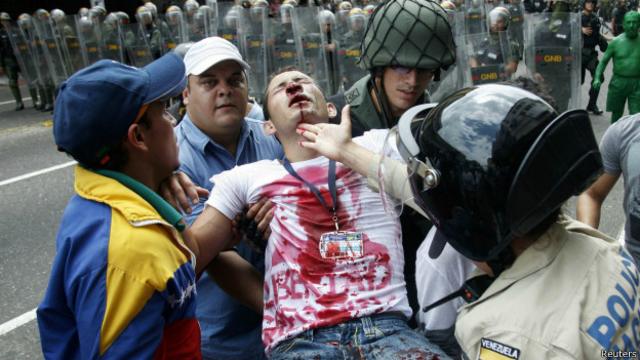
            Nuevas manifestaciones a un año de las protestas en Venezuela - BBC News  Mundo

    Furthermore, I experienced the worst traumatic moment in the protest. When I thought that everything was over, it was just the beginning. Home was not even secure during this protest. Some Venezuelans were attacked in their houses, and unfortunately, I was one of them. The protests started getting more aggressive and one day, I was at home with my family and praying that nothing bad would happen. On a Wednesday at noon, a group of people aggressively entered to my house yelling at us for not being outside fighting for our country. After they entered, those people thought that we were “Chavistas”, which means that we were from the side of the president. They started to slap me in my face, stole the food, and stole our car. I couldn’t feel worse that day. No food, no medicine, no gas, family, and friends passed away, and my family and I were not even secure at home. It was a feeling that I don’t wish for anybody. After those events, nothing can compare to what I felt in 2017.
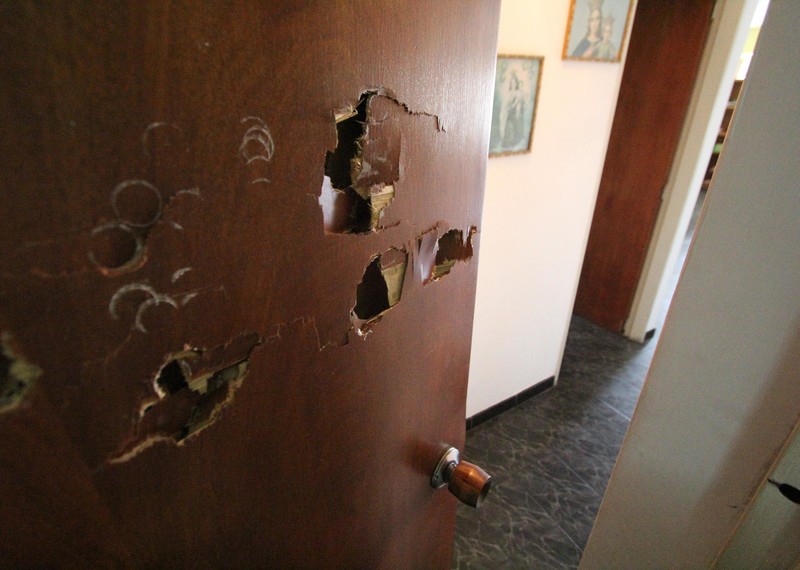
                     Venezuela: Repression taken into people's living rooms as home raids surge  - Amnesty International

    This protest affected Venezuelans in many ways. Some Venezuelans even lost their memory about what exactly happened due to this traumatic situation, but for many, it will be an unforgettable year filled with difficulties. Having lived days and months without electricity, water, food, medicine, and even without gas was one of the adversities that Venezuelans have experienced. After a storm, comes the radiant sun, a beautiful phrase that my maternal family used to say. Although the situation in my country is still bad, I’m now in another country and starting a new life, but I still hope that things in Venezuela can change.


This essay was written in memory of my deceased family members and friends.

Essay#2:Cause and Effect Essay

                                                             War Hero

There is a Chinese saying, “The world is beautiful because someone is carrying a heavy load for you”. It means Chinese people can enjoy a happy and peaceful life today because many selfless Chinese heroes died fighting for the country. My grandfather was one of those heroes. China was attacked by Japan during the Second World War. During the Japanese invasion, China was in the most painful situation where houses were destroyed, women were raped, and many people were killed. In 1938, Japan completely invaded Guangdong China, and my grandfather's parents were victims of this invasion. At that time, my grandfather was only sixteen years old. After losing his parents, my grandfather participated in the army bravely and fought in the Guangzhou War. After the war was over, he came back to Yunfu and married my grandmother. Although my grandfather has passed away, his experience has had a deep influence on our whole family and has shaped my character. 


One of the most important effects was that my grandfather improved our family’s standard of living. After the war, my grandfather soon got a good job when he returned to his hometown Yunfu. He learned how to fix planes during the war, so he arranged to work at a local business. He had a good income to satisfy all the demands of his family. From then on, my grandmother no longer worked in the fields, and she could stay at home to take care of my father and other siblings. Apart from this, he also left a good property for his children and his grandchildren. As a war hero, he made a big contribution to peaceful life in China. Therefore, my grandfather received compensation every year from the government. 


In addition, due to my grandfather’s hero status and spirit, my father was inspired to be a policeman who protected the country and people. When my father was growing up, he often listened carefully to my grandfather’s brave and painful stories that took place in the Second World War. These stories filled my father with justice and patriotism. After my father graduated from high school, he made a big decision to participate in the police school to serve China in any way he could. He knew that once he became a policeman, he could protect China better just like his father had done in the war. Furthermore, during my father’s career, he made many contributions to society’s security. I clearly remember one of the cases. Many years ago, a young woman was robbed of her money and killed in her house. Eventually, my father quickly found the criminal and detained him. My father was promoted and was praised by the government because he solved this case. Obviously, my grandfather’s spirit did not only affect my father’s job but also inspired him to take pains to protect society’s security.


Finally, my grandfather shaped my character and taught me the importance of justice and peace. Due to the eight-year painful war experience, there was only justice and darkness in my grandfather’s mind. His brave experiences inspired me to be a just person. For instance, when I was a child, my grandfather rode his bike to take me to the supermarket. While we were there, we witnessed a man who stole money from an old lady. My grandfather quickly chased the man, caught him bravely, and tied his hands with his belt. This event left a strong impression on me and deepened my belief of justice. Moreover, compared to my grandfather’s painful war life, I appreciate the peaceful life I have now. During the war, my grandfather was hungry and cold, lost his friends, and suffered hurt. I feel so lucky because my present life is happier, and I realize that happiness doesn't always come easily. Thus, I will cherish the happy life more now.


In conclusion, even though my grandfather passed away many years ago, his influence still lives on my family. I am very proud to be a granddaughter of such a wonderful and brave man. Because Chinese people cannot have a happy and peaceful life without heroes from the war, I am thankful for their efforts. At the moment, there are still many unfair and conflicts in the world. Therefore, the most important thing for people from all over the world is that we should try our best to protect the peace of the world.


Iran Revolution 1979

 The Revolution

            When the Iranian Revolution happened, I wasn't born yet. Iran was on its way to growing as a modern country, like new western nations, under the rule of Mohammad Reza Shah. However, many factors drove people toward revolution. Before the Pahlavi era, Iran was under control of the Qajar dynasty, whose inappropriate rulers greatly harmed Iran’s economy and culture. People were angry about the Qajar dynasty and desired a Republic, but instead the Pahlavi monarchy took power. Mohammad Reza Shah tried to westernize Iran’s culture and most parts of the industry were under the control of western professionals, such as oil. Additionally, when Mosaddeq nationalized the oil, Britain, supported by US and the Shah, staged a coup against him. It made people angrier. Moreover, freedom of speech was completely limited, and protesting could cause jail or death. During this time, religious leaders gained popularity. The revolution began from universities and mosques to change the government from a monarchy to a Republic. However, after a year, Ayatollah Khomeini gained so much power and popularity, and he forced the Shah to leave Iran. This was the moment the government changed to an Islamic Republic. The history of Iran and the lives of millions Iranian changed in several ways after the revolution.

After the Revolution, the first part of society that was affected was the economy. Changing the government made the relationship between Iran and Western countries worse. Western governments put sanctions on Iran, stopped trading with Iran and helped Iraq to start a war with Iran. It caused Iran’s economy to crash. Most brands and western markets cut their own relationships with Iran, and Iranians had to take control of businesses that were run by western professionals who left after the revolution. In a few years, Iranians took the control and defended against Iraqi invasion, but the effects of war and the economic crash were big enough to even affect me when I was growing up. An unstable economy was never truly fixed and always affected people’s life in various ways. Prices rise every year, and the Iranian Rial lost worth in the international market. During that time, The Islamic government moved towards dictatorship step by step.

After the Revolution, people's freedom of speech became more limited. Religious leaders gained so much power in the government, and they pushed aside wise and educated people in the government. They tried to influence all universities, schools, and workplaces with religious laws, and they controlled religious beliefs, by censoring books, movies, music, and art. The censoring and the belief control were so strong in the few first years after the revolution. During the time I was growing up, I had easier access to movies and books than my parents. I grew up watching a lot of movies from different countries. Many actresses, actors, and singers left the country after revolution but continued their art from outside of Iran. Many TV shows and news channels started working to cover the truths that the government was trying to hide. People started using satellite dishes, and the government couldn't do anything about it. People always found a way to access everything that the government tried to censor or limit.

After the Revolution, women faced several limitations. Before the revolution, women started to have significant access to education, participating in universities and held high positions in society and government. However, religious leaders didn’t support women in power. They believe men should be in charge. The government forced women to wear a hijab in all places by law. Pressure and laws limited women’s freedom in various parts of society. Even singing was forbidden for women, and the brainwashing of girl students started in schools. I faced all these pressures and limitations when I was growing up. When my mother was my age, laws and pressure against women were stronger than in my time, but it was still enough to make me want to leave the country.

The revolution took a wrong turn and has had a big effect on every Iranian. The situation in Iran, today isn't much different from previous dictatorships. All these changes and rules have affected my life, my parents’ lives, and will affect the lives of many generations in Iran. Growing up after the revolution made me more careful about beliefs and politics. Fortunately, despite government efforts, they couldn't stop women and people from standing up for their rights. Religious law and beliefs don't have the same effect, popularity, or powers as they had during the revolution. Women continue their way to have high positions in science and government and they no longer follow the rule of hijab and fight for the freedom to choose whether to wear hijab or not. After the death of Mahsa Amini, a 22-year-old girl due to the hijab rule, people, students, and the young generation protest against Islamic Republic in every possible way, more than before, and keep fighting for woman, life and freedom.

Thursday, March 28, 2024

Different Direction

 Different Direction

       My family has walked on a straight road for a long time, but they discovered a big hole in the center. They had to change the direction. In 1966, the Cultural Revolution started in China, and the whole country entered a big crisis because Chairman Mao wanted to preserve communism and avoid capitalism. Then, he launched reform. It caused many communists to be against intellectuals and private land ownership. My great-grandfather who was a teacher killed himself because he could not bear the criticism. Moreover, my grandparents rented three houses in the village were criticized, too. They lost their social status, and the family was in decline. Two years later, Deng Xiao Ping pointed out the mistake in the Cultural Revolution. He tried to make the economy recover, so he created Reform and Opening Up. The majority of people had many opportunities to change their lives at that time. As a result, my family also started looking for a new way to live and exist in China.

       In the beginning, my family found it hard to save themselves. After the Cultural Revolution, they lost everything in the village. They did not have any income, so their life became terrible. They did not have enough money to buy food, and they needed to walk to the food bureau to get some food at dawn because the food bureau was far from their house. The traffic was inconvenient in the village, and it also difficult to walk. Moreover, my father did not have anything to do. He could not go to school because my grandparents could not afford it, and he did not have any friends. Children in the village were warned by their parents not to play with my father because their families were afraid to help others at that time. They could only solve their own problems. If they helped other people one time, some people would ask them for help again and again. That would bring people who lent a helping hand into trouble. This makes my father lonely.

       However, my family moved to a city to start a new life during the Reform and Opening period. They tried to leave the bad memories behind them and make a change. They thought living in the city was more convenient than living in the village because the roads were more modern. The bus stop was about five minutes from their house, so they could go out and buy things easily. In addition, my grandfather contributed to Reform and Opening Up. He actively responded to reforms and met a person who was good at architecture. He learned some skills about architecture from that person. He earned money after he became a builder. Our house in China was also built by my grandfather and his friends.

       Furthermore, my father had an opportunity to change his life. Everything was new in his eyes when he went to the city for the first time. He went to school again and found his other half. My mother met him in a painting class because my father’s major was drawing, and he practiced there every day. My mother had a similar experience with my father, so they had things in common. They often talked about how they lived through their terrible childhood. They quickly fell in love, and a few years later, they got married. They saw many people catch the chance to earn money during the reform, so they started to open a business. Then, they opened a grocery, but it was not an easy job. After they moved many places and tried many times, the business picked up.

       My family changed their lives in the correct direction. For example, they tried to forget the bad memories and moved to a city. That caused everything to change in a positive way. Before I came to the U.S., I enjoyed the fruits of their labor, so I had good surroundings and education and did not need to care about food or money. I think if we find something wrong on our road, we should not stop. We can change a direction, so we may find a better life.

Wednesday, March 27, 2024

City Life


City Life

Parents always want the best for their children even though this can represent a big sacrifice. A good example of this happened to my family a couple of years ago. When my mother was in high school, my grandparents decided to start looking for better opportunities for their daughters instead of remaining in the same place in Chihuahua for the rest of their lives. They used to live in a small village, and the only nearby high school was boarding School four hours away. In addition, the universities were in the city, so they analyzed the options and decided to move to Chihuahua City, which is the capital of the state. Even though they knew this would be a big change, they decided to take the chance and move.


At the beginning, it was hard for everybody because not only did they have to say goodbye to everything they knew, but they also divided forces, some stayed in the city and some others at the village. The principal source of income for the family was my grandfather’s activities as a cattleman and farmer. Moreover when all the women moved to find their way in the city, they were grappling with this new life and all that it brought. My grandfather stayed at his farm, and only visited them during the fallow period. My grandmother always mentioned that the hardest part of this movement was to find a home. She mentioned that my grandfather just gave her the money and told her to take the girls and find a house. When it happened, she took with her the four youngest of their daughters that were not at school at that moment and went to Chihuahua with the intention to buy a house. This way when the rest if the family came, there was already a place for them to stay.


Another thing that the family had to deal with were different traditions and opportunities in this big city. This new city represented a new challenge for all the members because of the life they were accustomed to having. For the ones that attended  the boarding school, this new school was very difficult. This new school was very noisy and stressful, and male classmates were allowed at the classrooms. For the rest of the daughters that were older enough to work, they had to get a part time job to support the house. When I asked them, all agreed that one of worst parts was to adapt to the new kind of food. The oldest of the daughters, Josefina, always mentioned that she missed the big red guayabas a lot, that she used to cut from the tree, they also missed the fresh cheese the local farmers used to make, and the dry beef they eat every time they slaughter a cow.


A lot of memories have been lost since my grandparents made this decision. Some photos remain from that life. However, none of the third generations or the grandsons and granddaughters had the opportunities to go there because of the poor road conditions, is winding and unpaved. Even if my grandfather still wore boots, all his grandchildren are distant to have idea or to know the job he used to do at his farm. One thing is certain which is their daughters improved themselves. All of them attended high school and some of them went to the university.


When I look back in time, I thank my grandparents for being brave to make that decision to move to Chihuahua City. I have started to feel the same way because I decided to move to the United States with my family, looking for better life and adapting to a new country. Sometimes I think about it and ask myself if I prefer to be a country woman instead of a city woman, the one who is scared of the bugs and attends to the zoo to see the animals or the one that can be able to be in touch with nature and understand the cattle business. I am sure that I will find out in a couple of years. It is just a matter of time.

Sunday, March 24, 2024

essay #2

                                                                     Economic Crisis 

I am a Venezuelan born to Chinese parents. I lived in Margarita city for more than fifteen years, and I liked it so much. Venezuela used to be a country with a very good economy. My parents immigrated to Venezuela and lived there for almost thirty years to make a business, and they enjoyed their life there. However, in Venezuela a huge change occurred in 2013. The president Hugo Chavez died, and the country started rioting. People fought for food and a lot of people died from starvation and fighting. It is still unimaginable what happened in my home country when the country fell into an economic crisis and widespread poverty. The economic crisis had seeped into the whole country, and it affected my entire family. 

At the beginning, during the economic crisis, getting resources was difficult for my family. There was insufficient food, medicine and daily necessities, so getting these things like meat, toilet paper and rice became a daily routine. Every day my parents would have to line up to wait and buy these items. Even though my family had enough money, there was not enough food to buy in the stores. Because of the supply shortage, sometimes my parents and I did not have food to eat. Usually, my parents went to buy food in the morning at the supermarket, but they had to wait two or three hours to buy some food and it was not enough for a few days. The shortage of resources made it impossible for us to live. For example, when I was sick, my parents went to a pharmacy, but there was no medicine to buy. These shortages of resources affected my family physically and it was getting worse as the months passed by.  

In addition, during the economic crisis, my family felt unsafe. Because of the shortage of resources, people started lining up every day to buy food, but they were not able to get enough. It was serious enough to cause starvation for some. A lot of people fought and scrambled for the resources, and some ended up killing others for food. At that time, my parents had a small snack store. Because due to the lack of food, people went into my parents’ store and started to steal things, so my family decided to close the store for good. It was the only way to reduce losses. 


After many years of suffering, my parents decided to move to the U.S. They started to think and plan how our family was going to leave. However, my father could not sell his business or house because of the crisis. People did not have the resources to buy property. A lot of people did not have money to buy a house or car because it was so expensive, so my father decided to give up our house and business. It caused my family to not have enough money to leave. Fortunately, some family members who lived in China offered to lend us money so we could leave. Based on this money, we eventually made our way to Chicago, and we started living and working in the U.S. 

Venezuela used to be a great country, but a lot of problems happened after Hugo Chavez died. When the Venezuelan economic crisis started in 2013, I felt like nothing bad would happen, but a lot of unimaginable things happened. Fortunately, my entire family started a new life in the U.S and it changed for the better. 


Essay 2 - Single Child Era

    The one-child policy was a family planning policy promoted by the Chinese government from 1979 to 2015. In 1979, the government realized the urban population was growing and lacked resources, so they initiated this law to control the overpopulation. This policy said that each family could only have one child. If the family wanted a second child, it required approval from the government. When a family violated the rule by having a second child without permission, it was necessary to pay a costly fine. Usually, women were given IUDs to prevent pregnancy after giving birth. However, there were some exceptions that included families that lived in the countryside and had rural household registration and non-public servants. They could have the opportunity to have one more child. This policy also symbolized that the fate of millions of people was about to change in many ways. I was born in 2001, so I felt the impact of the policy during my childhood, and I am a single daughter.

    Selfishness was one of the biggest prejudices against only children. Many people think children who grow up in a one-child family must be very selfish because they are not used to sharing things with others. However, I think that sharing is a thing that comes from education, values, and family environment. I grew up judged to be selfish. When I was four years old, my cousin always criticized me for not sharing things with others. At that time, I hated haircuts, so my aunt would buy me an ice cream after every haircut appointment as a bravery medal. Things seemed to occur very strangely in those years. I never got the chance to eat my haircut reward because I always got sick, and my cousins always ate my ice cream causing me to cry bitterly. I always thought that I was a selfish person until my parents told me that I was not selfish to myself. Every child has a time when they cry or pray to their parents to buy them toys or snacks, but I did not have those issues. My mother told me that I always asked them to buy me something, and if they said no, I would not get on the floor or start throwing a tantrum. Maybe because I explicitly knew that the economic condition of my family was not good. Although I have become more selfish as I grow up, I have double standards about that because sometimes I do not like to share my favorite things with people who I do not like.

    In addition, since I was a single daughter, I frequently felt lonely and had difficulty in making decisions. When I was in primary school, half of my classmates had siblings. I always felt envious because they always had someone to go home with. I remember at that time, students had to be picked up by their parents before they could leave school. My mother was the one who went to school to pick me up after class. One day, my mother was very busy and could not come to pick me up. Without any siblings, I had to stay at school with the janitor until the evening. That day was also the day when I begged my mother to give me a brother or sister because if my siblings were in the same school as me, I would not need my parents to pick me up. I wanted to have a sibling not only because I felt lonely but also because I would like to talk about it with someone besides my parents when I have difficulty of making decisions. Sometimes there were some secrets and situations that I could not share with my parents, so having a sibling could have helped me.

    Finally, as the only child, I need to care for my parent's burden. As I grew older, I thought a lot about my future and my parents' future. A few months ago, my mother retired in China but not in the U.S., so I started thinking about when both of my parents will retire and no longer be able to work. Parental pension issues may be a big burden because I do not have siblings to divide the responsibility of care of my parents. I must work by myself but spend it with three people. Just thinking about it gives me a headache. Even though it is too early to think about and I know that the government would give pensions, it is not enough. Being an only child is quite stressful. The cycle of work, family, and personal life while taking care of my parents will be stressful. This can lead me to feel physically and mentally exhausted and struggle to cope with the challenges of daily life. Its not that I am ungrateful or do not want to be dutiful to my parents, but I feel like it might be less pressure if I had siblings.


    The one-child policy was like a complex experiment. Many people think that a child who grow up in a single-child family has advantages because they can have more love, concern, and self-development. On the other hand, there are some inevitable consequences. For instance, these people may feel lonely and under pressure because of the pension problems. However, I think the one-child policy has now changed. In the past, people wanted to have children, but the government did not allow them, while now people don't want to have children, but the government promotes a second or even third child. These ideas are contradictory to each other. In the long term, this could be a vast consequence to the society. Moreover, it is a challenge for the future of the nation that has to be overcome because even though the economy in China looks good, not everybody is able to buy a house or car. This causes the young generation to prefer not to get married or have a child. Thus, I sometimes think one-child policy had its advantages and disadvantages.

Saturday, March 23, 2024

essay #1

                                                                          New Life 

Five years ago, my family decided to move to Chicago from China. I was surprised when they told me about it because I never thought about moving to the U.S. Moving to Chicago was difficult for me and my family because we had to start our new life over again in a new place, but I was curious about what the city had to offer. There are many kinds of people in Chicago from everywhere in the world. The cause of this was there are so many languages and people that was all new for me. In my new life in Chicago, I have both embraced and rejected some part of the culture. I have gained into the education and employment and learned adapted to living in some unsafe area. 

Education was one of many parts of American culture that I have embraced more. I enjoy studying with people from different nations, and that has made my new life interesting. Meeting new people in school has helped me learn new things. For example, I can learn about their culture, language, and religion. When I went to high school in Chicago, I could talk in class and express myself, and it helped me learn more about speaking skills. In addition, working in Chicago is more convenient than home in Venezuela. There are more job opportunities in Chicago, so it has allowed me to explore different kinds of work. These job opportunities allow me to try out different roles and discover which job is more suitable for me. By working hard in Chicago, I believe I will be able to achieve my dreams in the future. 

However, the lack of safety has been hard to adapt to. In Chicago, there is too much crime and shootings near where I live. I was worried about walking alone at night when I got off from work because I was afraid that someone could appear with a gun. Even though the police and community groups are trying to find a solution for this, safety is still a big problem for me living in Chicago. Though I have this feeling, I still must accept this reality because I need to live in this city for now. In addition, I have noticed that the homelessness issue is significant in Chicago. On the streets of the city, I always see homeless people asking for money or food. Some streets and neighborhoods have a lot of trash, and it smells nasty. This causes the city to look bad. I do not understand why there are many homeless people around the city. I think the government should plan and make some solutions.   

In conclusion, having a new life in Chicago is a good start for this new phase of my life. I enjoy education in the U.S. because I can enjoy it with different people from countries around the world. It has been exciting to study in a new place. Moreover, working hard in Chicago could help me achieve my goals and dreams. Chicago is a city with several problems, like safety and homeless people everywhere, but I still have hope that it will get better in the future. I learned that my new life in Chicago was difficult at the beginning, but it has become very interesting and exciting. 


Ten Days of Protest

                                                    .   Ten Days of Protest   Imagine if all the trucks in Brazil suddenly stopped moving, t...